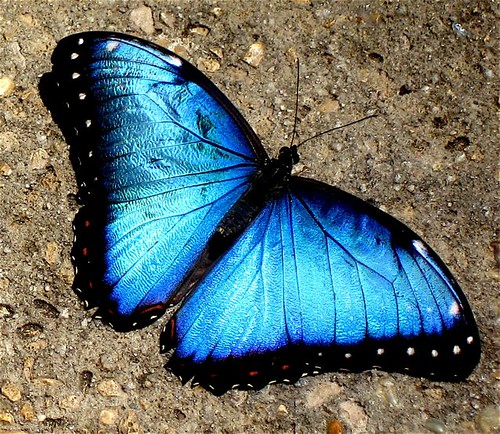
A Morpho butterfly may be one of over 80 species of the genus Morpho. They are Neotropical butterflies found mostly in South America as well as Mexico and Central America. Morphos range in wingspan from the 7.5 cm (3 inch) M. rhodopteron to the imposing 20 cm (8 inch) Sunset Morpho, M. hecuba. The name Morpho, meaning changed or modified, is also an epithet of Aphrodite and Venus.
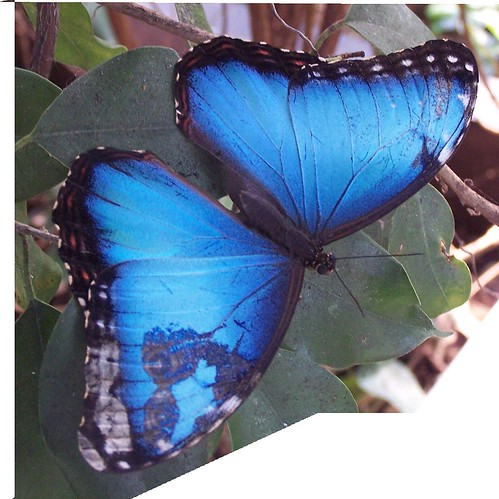
Many Morpho butterflies are colored in metallic, shimmering shades of blue and green. These colors are not a result of pigmentation but are an example of iridescence: the microscopic scales covering the Morpho's wings reflect incident light repeatedly at successive layers, leading to interference effects that depend on both wavelength and angle of incidence/observance. Thus the colors produced vary with viewing angle, however they are actually surprisingly uniform, perhaps due to the tetrahedral (diamond-like) structural arrangement of the scales or diffraction from overlying cell layers. This structure may be likened to a photonic crystal. The lamellate structure of their wing scales has been studied as a model in the development of fabrics, dye-free paints, and anti-counterfeit technology used in currency.
The iridescent lamellae are only present on the dorsal side of their wings, leaving the ventral side brown.
The ventral side is decorated with ocelli or eyespots. In some species, such as M. godarti, the dorsal lamellae are so thin as to allow the ventral ocelli to peek through. While not all Morphos have iridescent coloration, they all have ocelli. In most species only the males are colorful, supporting the theory that the coloration is used for intrasexual communication between males. The lamellae reflect up to 70% of light falling on them, including any ultraviolet (UV). The eyes of Morpho butterflies are thought to be highly sensitive to UV light and therefore the males are able to see each other from great distances. Some South American species are reportedly visible by the human eye up to one kilometre away.
There also exist a number of white Morpho species, principal among these being M. catenarius and M. laertes. An unusual species that is fundamentally white in coloration, but which exhibits a stunning purple iridescence when viewed at certain angles is the rare M. sulkowskyi, while among the metallic blue Morpho species, M. rhetenor stands out as the most iridescence of all, with M. cypris a close second. Indeed, M. cypris is notable in that specimens that are mounted in entomological collections will exhibit color differences across the wings if they are not 'set' perfectly flat.
The iridescent lamellae are only present on the dorsal side of their wings, leaving the ventral side brown.
The ventral side is decorated with ocelli or eyespots. In some species, such as M. godarti, the dorsal lamellae are so thin as to allow the ventral ocelli to peek through. While not all Morphos have iridescent coloration, they all have ocelli. In most species only the males are colorful, supporting the theory that the coloration is used for intrasexual communication between males. The lamellae reflect up to 70% of light falling on them, including any ultraviolet (UV). The eyes of Morpho butterflies are thought to be highly sensitive to UV light and therefore the males are able to see each other from great distances. Some South American species are reportedly visible by the human eye up to one kilometre away.
There also exist a number of white Morpho species, principal among these being M. catenarius and M. laertes. An unusual species that is fundamentally white in coloration, but which exhibits a stunning purple iridescence when viewed at certain angles is the rare M. sulkowskyi, while among the metallic blue Morpho species, M. rhetenor stands out as the most iridescence of all, with M. cypris a close second. Indeed, M. cypris is notable in that specimens that are mounted in entomological collections will exhibit color differences across the wings if they are not 'set' perfectly flat.